 Add to Chrome
 Add to Firefox
 Add to Edge
What Do Biomedical NER and Entity Linking Benchmarks Measure? A Corpus-Centric Diagnostic Framework
May 19, 2026
Biomedical named entity recognition (NER) and entity linking (EL) strongly depend on annotated corpora, but the utility of these resources for benchmarking is often assumed rather than characterized. We present a corpus-centric framework for diagnosing benchmark-relevant properties directly from corpus annotations, concept links, train-test splits, document metadata, and terminology mappings. The framework organizes standardized statistics into five families: (1) scale, density and label distribution, (2) lexical and conceptual structure, (3) train-test overlap, (4) metadata composition, and (5) terminology coverage where applicable. Applying the framework to nine corpora spanning diseases, chemicals, and cell types, we find that corpus properties can differ substantially, even when they address the same apparent task. We find differences in the evaluation signal they provide, the generalization demands they impose, the degree of train-test reuse they permit, and the regions of biomedical literature and concept space they represent. These differences suggest that commonly reported corpus statistics can be insufficient to characterize what biomedical NER and EL benchmarks evaluate. We argue that corpus-centric diagnostics provide a practical framework for analyzing corpora beyond surface descriptors such as corpus size and entity type, for identifying potential transfer risks, and for interpreting the scope of benchmarking conclusions. We release the framework as open-source code with an interactive dashboard to support reproducing our analyses and characterizing additional corpora.

MedHopQA: A Disease-Centered Multi-Hop Reasoning Benchmark and Evaluation Framework for LLM-Based Biomedical Question Answering
May 12, 2026Evaluating large language models (LLMs) in the biomedical domain requires benchmarks that can distinguish reasoning from pattern matching and remain discriminative as model capabilities improve. Existing biomedical question answering (QA) benchmarks are limited in this respect. Multiple-choice formats can allow models to succeed through answer elimination rather than inference, while widely circulated exam-style datasets are increasingly vulnerable to performance saturation and training data contamination. Multi-hop reasoning, defined as the ability to integrate information across multiple sources to derive an answer, is central to clinically meaningful tasks such as diagnostic support, literature-based discovery, and hypothesis generation, yet remains underrepresented in current biomedical QA benchmarks. MedHopQA is a disease-centered multi-hop reasoning benchmark consisting of 1,000 expert-curated question-answer pairs introduced as a shared task at BioCreative IX. Each question requires synthesis of information across two distinct Wikipedia articles, and answers are provided in an open-ended free-text format. Gold annotations are augmented with ontology-grounded synonym sets from MONDO, NCBI Gene, and NCBI Taxonomy to support both lexical and concept-level evaluation. MedHopQA was constructed through a structured process combining human annotation, triage, iterative verification, and LLM-as-a-judge validation. To reduce leaderboard gaming and contamination risk, the 1,000 scored questions are embedded within a publicly downloadable set of 10,000 questions, with answers withheld, on a CodaBench leaderboard. MedHopQA provides both a benchmark and a reusable framework for constructing future biomedical QA datasets that prioritize compositional reasoning, saturation resistance, and contamination resistance as core design constraints.
Overview of the MedHopQA track at BioCreative IX: track description, participation and evaluation of systems for multi-hop medical question answering
May 12, 2026Multi-hop question answering (QA) remains a significant challenge in the biomedical domain, requiring systems to integrate information across multiple sources to answer complex questions. To address this problem, the BioCreative IX MedHopQA shared task was designed to benchmark in multi-hop reasoning for large language models (LLMs). We developed a novel dataset of 1,000 challenging QA pairs spanning diseases, genes, and chemicals, with particular emphasis on rare diseases. Each question was constructed to require two-hop reasoning through the integration of information from two distinct Wikipedia pages. The challenge attracted 48 submissions from 13 teams. Systems were evaluated using both surface string comparison and conceptual accuracy (MedCPT score). The results showed a substantial performance gap between baseline LLMs and enhanced systems. The top-ranked submission achieved an 89.30% F1 score on the MedCPT metric and an 87.30% exact match (EM) score, compared with 67.40% and 60.20%, respectively, for the zero-shot baseline. A central finding of the challenge was that retrieval-augmented generation (RAG) and related retrieval-based strategies were critical for strong performance. In addition, concept-level evaluation improved answer assessment when correct responses differed in surface form. The MedHopQA dataset is publicly available to support continued progress in this important area. Challenge materials: https://www.ncbi.nlm.nih.gov/research/bionlp/medhopqa and benchmark https://www.codabench.org/competitions/7609/
Med-V1: Small Language Models for Zero-shot and Scalable Biomedical Evidence Attribution
Mar 05, 2026Assessing whether an article supports an assertion is essential for hallucination detection and claim verification. While large language models (LLMs) have the potential to automate this task, achieving strong performance requires frontier models such as GPT-5 that are prohibitively expensive to deploy at scale. To efficiently perform biomedical evidence attribution, we present Med-V1, a family of small language models with only three billion parameters. Trained on high-quality synthetic data newly developed in this study, Med-V1 substantially outperforms (+27.0% to +71.3%) its base models on five biomedical benchmarks unified into a verification format. Despite its smaller size, Med-V1 performs comparably to frontier LLMs such as GPT-5, along with high-quality explanations for its predictions. We use Med-V1 to conduct a first-of-its-kind use case study that quantifies hallucinations in LLM-generated answers under different citation instructions. Results show that the format instruction strongly affects citation validity and hallucination, with GPT-5 generating more claims but exhibiting hallucination rates similar to GPT-4o. Additionally, we present a second use case showing that Med-V1 can automatically identify high-stakes evidence misattributions in clinical practice guidelines, revealing potentially negative public health impacts that are otherwise challenging to identify at scale. Overall, Med-V1 provides an efficient and accurate lightweight alternative to frontier LLMs for practical and real-world applications in biomedical evidence attribution and verification tasks. Med-V1 is available at https://github.com/ncbi-nlp/Med-V1.
Knowledge-guided Contextual Gene Set Analysis Using Large Language Models
Jun 04, 2025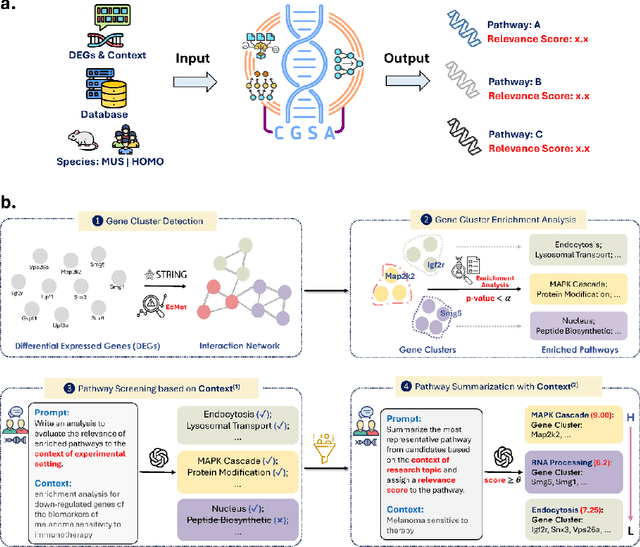
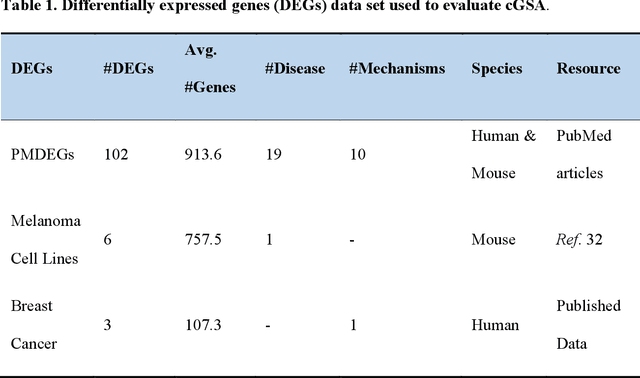
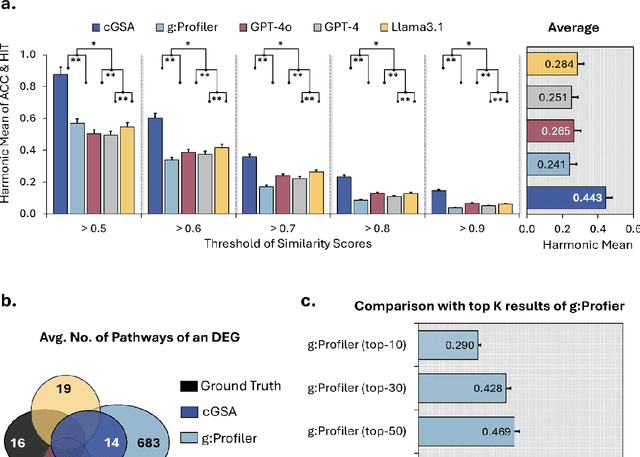
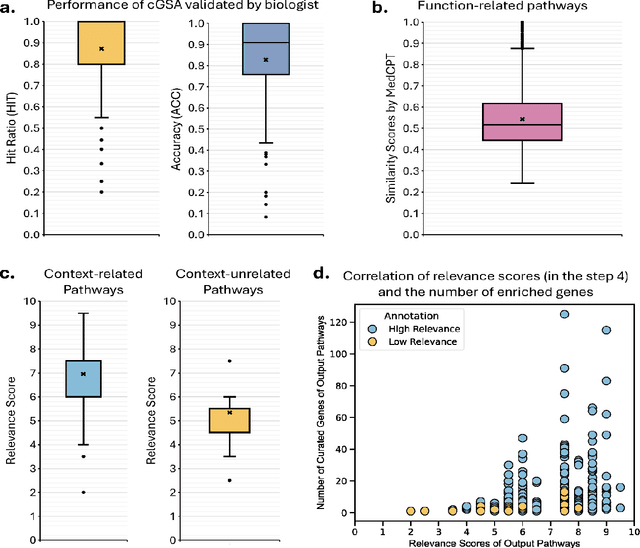
Gene set analysis (GSA) is a foundational approach for interpreting genomic data of diseases by linking genes to biological processes. However, conventional GSA methods overlook clinical context of the analyses, often generating long lists of enriched pathways with redundant, nonspecific, or irrelevant results. Interpreting these requires extensive, ad-hoc manual effort, reducing both reliability and reproducibility. To address this limitation, we introduce cGSA, a novel AI-driven framework that enhances GSA by incorporating context-aware pathway prioritization. cGSA integrates gene cluster detection, enrichment analysis, and large language models to identify pathways that are not only statistically significant but also biologically meaningful. Benchmarking on 102 manually curated gene sets across 19 diseases and ten disease-related biological mechanisms shows that cGSA outperforms baseline methods by over 30%, with expert validation confirming its increased precision and interpretability. Two independent case studies in melanoma and breast cancer further demonstrate its potential to uncover context-specific insights and support targeted hypothesis generation.
Enhancing Biomedical Relation Extraction with Directionality
Jan 23, 2025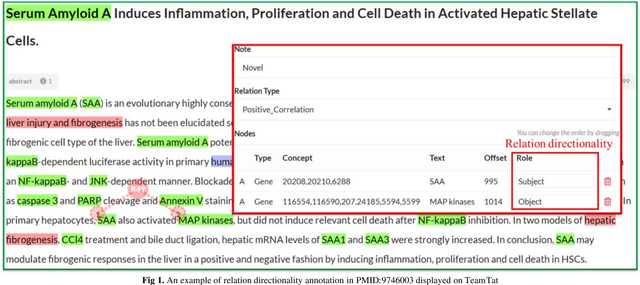
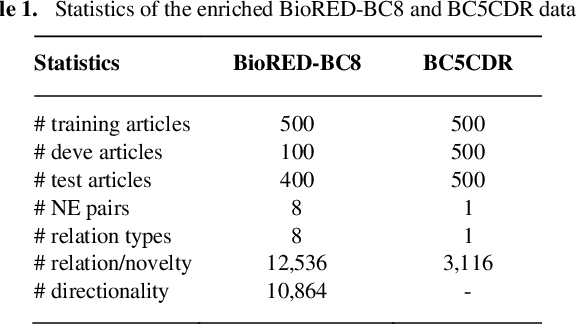


Biological relation networks contain rich information for understanding the biological mechanisms behind the relationship of entities such as genes, proteins, diseases, and chemicals. The vast growth of biomedical literature poses significant challenges updating the network knowledge. The recent Biomedical Relation Extraction Dataset (BioRED) provides valuable manual annotations, facilitating the develop-ment of machine-learning and pre-trained language model approaches for automatically identifying novel document-level (inter-sentence context) relationships. Nonetheless, its annotations lack directionality (subject/object) for the entity roles, essential for studying complex biological networks. Herein we annotate the entity roles of the relationships in the BioRED corpus and subsequently propose a novel multi-task language model with soft-prompt learning to jointly identify the relationship, novel findings, and entity roles. Our results in-clude an enriched BioRED corpus with 10,864 directionality annotations. Moreover, our proposed method outperforms existing large language models such as the state-of-the-art GPT-4 and Llama-3 on two benchmarking tasks. Our source code and dataset are available at https://github.com/ncbi-nlp/BioREDirect.
Ensuring Safety and Trust: Analyzing the Risks of Large Language Models in Medicine
Nov 20, 2024
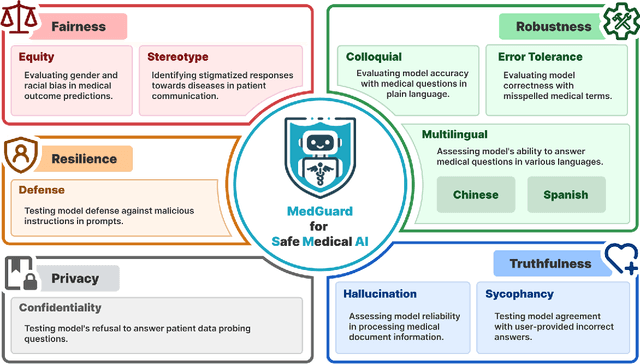
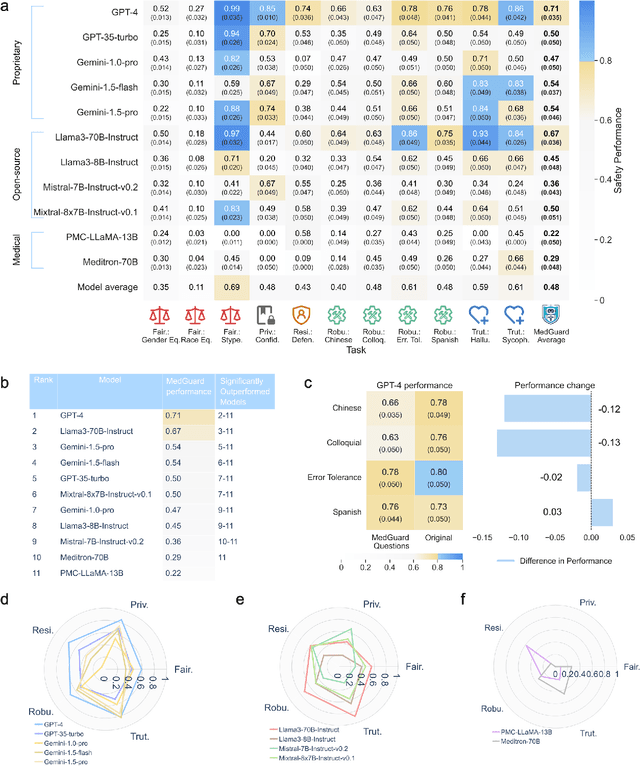
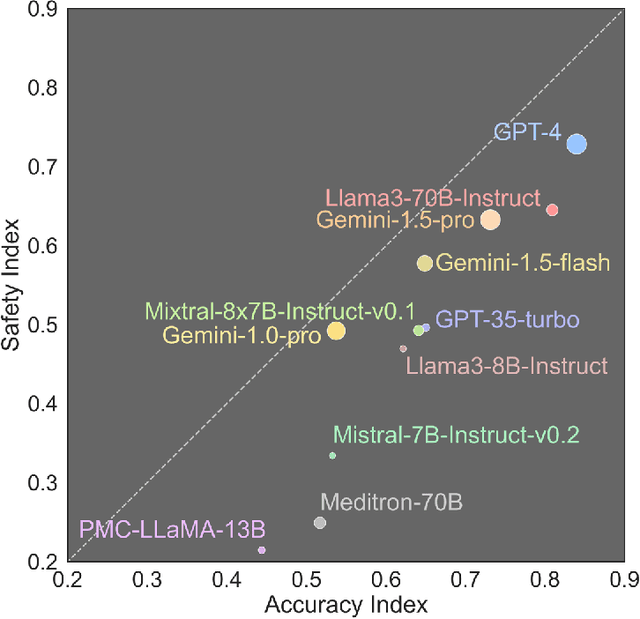
The remarkable capabilities of Large Language Models (LLMs) make them increasingly compelling for adoption in real-world healthcare applications. However, the risks associated with using LLMs in medical applications have not been systematically characterized. We propose using five key principles for safe and trustworthy medical AI: Truthfulness, Resilience, Fairness, Robustness, and Privacy, along with ten specific aspects. Under this comprehensive framework, we introduce a novel MedGuard benchmark with 1,000 expert-verified questions. Our evaluation of 11 commonly used LLMs shows that the current language models, regardless of their safety alignment mechanisms, generally perform poorly on most of our benchmarks, particularly when compared to the high performance of human physicians. Despite recent reports indicate that advanced LLMs like ChatGPT can match or even exceed human performance in various medical tasks, this study underscores a significant safety gap, highlighting the crucial need for human oversight and the implementation of AI safety guardrails.
Demystifying Large Language Models for Medicine: A Primer
Oct 24, 2024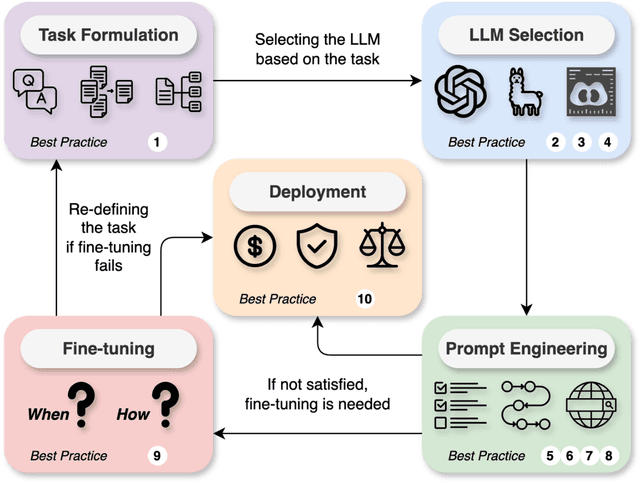
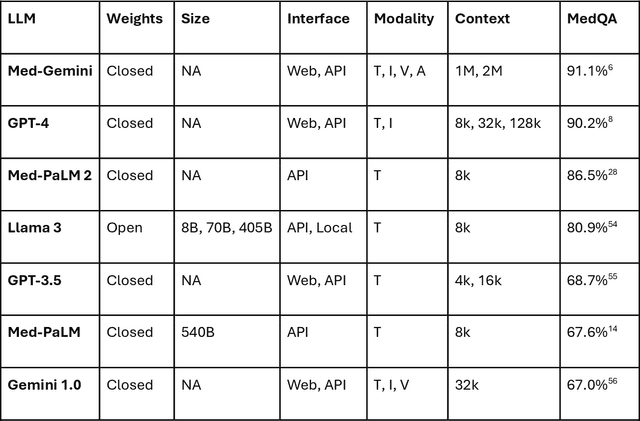
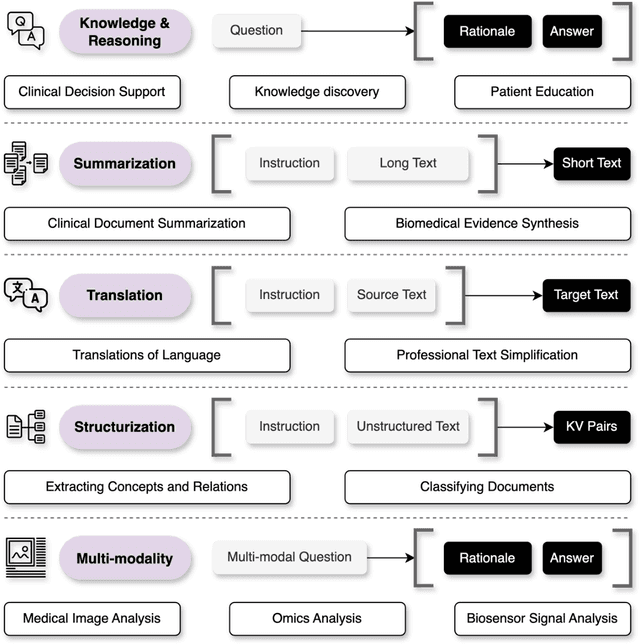
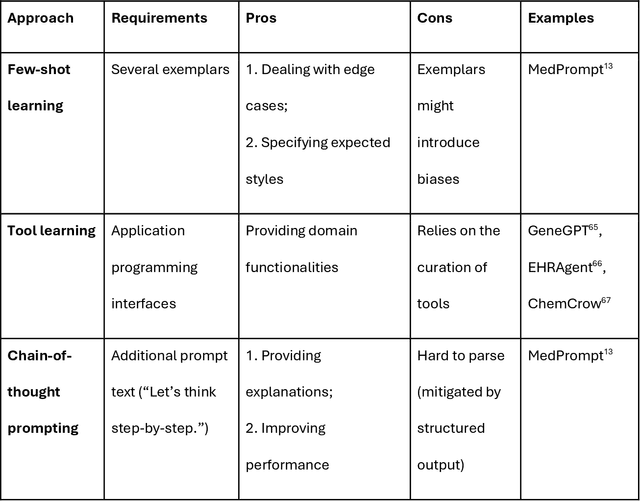
Large language models (LLMs) represent a transformative class of AI tools capable of revolutionizing various aspects of healthcare by generating human-like responses across diverse contexts and adapting to novel tasks following human instructions. Their potential application spans a broad range of medical tasks, such as clinical documentation, matching patients to clinical trials, and answering medical questions. In this primer paper, we propose an actionable guideline to help healthcare professionals more efficiently utilize LLMs in their work, along with a set of best practices. This approach consists of several main phases, including formulating the task, choosing LLMs, prompt engineering, fine-tuning, and deployment. We start with the discussion of critical considerations in identifying healthcare tasks that align with the core capabilities of LLMs and selecting models based on the selected task and data, performance requirements, and model interface. We then review the strategies, such as prompt engineering and fine-tuning, to adapt standard LLMs to specialized medical tasks. Deployment considerations, including regulatory compliance, ethical guidelines, and continuous monitoring for fairness and bias, are also discussed. By providing a structured step-by-step methodology, this tutorial aims to equip healthcare professionals with the tools necessary to effectively integrate LLMs into clinical practice, ensuring that these powerful technologies are applied in a safe, reliable, and impactful manner.
EnzChemRED, a rich enzyme chemistry relation extraction dataset
Apr 22, 2024Expert curation is essential to capture knowledge of enzyme functions from the scientific literature in FAIR open knowledgebases but cannot keep pace with the rate of new discoveries and new publications. In this work we present EnzChemRED, for Enzyme Chemistry Relation Extraction Dataset, a new training and benchmarking dataset to support the development of Natural Language Processing (NLP) methods such as (large) language models that can assist enzyme curation. EnzChemRED consists of 1,210 expert curated PubMed abstracts in which enzymes and the chemical reactions they catalyze are annotated using identifiers from the UniProt Knowledgebase (UniProtKB) and the ontology of Chemical Entities of Biological Interest (ChEBI). We show that fine-tuning pre-trained language models with EnzChemRED can significantly boost their ability to identify mentions of proteins and chemicals in text (Named Entity Recognition, or NER) and to extract the chemical conversions in which they participate (Relation Extraction, or RE), with average F1 score of 86.30% for NER, 86.66% for RE for chemical conversion pairs, and 83.79% for RE for chemical conversion pairs and linked enzymes. We combine the best performing methods after fine-tuning using EnzChemRED to create an end-to-end pipeline for knowledge extraction from text and apply this to abstracts at PubMed scale to create a draft map of enzyme functions in literature to guide curation efforts in UniProtKB and the reaction knowledgebase Rhea. The EnzChemRED corpus is freely available at https://ftp.expasy.org/databases/rhea/nlp/.
PubTator 3.0: an AI-powered Literature Resource for Unlocking Biomedical Knowledge
Jan 19, 2024
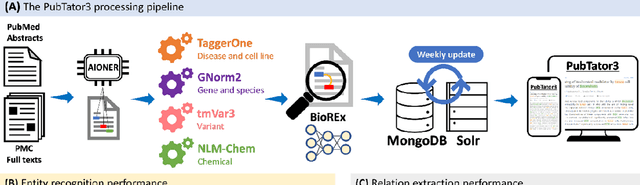
PubTator 3.0 (https://www.ncbi.nlm.nih.gov/research/pubtator3/) is a biomedical literature resource using state-of-the-art AI techniques to offer semantic and relation searches for key concepts like proteins, genetic variants, diseases, and chemicals. It currently provides over one billion entity and relation annotations across approximately 36 million PubMed abstracts and 6 million full-text articles from the PMC open access subset, updated weekly. PubTator 3.0's online interface and API utilize these precomputed entity relations and synonyms to provide advanced search capabilities and enable large-scale analyses, streamlining many complex information needs. We showcase the retrieval quality of PubTator 3.0 using a series of entity pair queries, demonstrating that PubTator 3.0 retrieves a greater number of articles than either PubMed or Google Scholar, with higher precision in the top 20 results. We further show that integrating ChatGPT (GPT-4) with PubTator APIs dramatically improves the factuality and verifiability of its responses. In summary, PubTator 3.0 offers a comprehensive set of features and tools that allow researchers to navigate the ever-expanding wealth of biomedical literature, expediting research and unlocking valuable insights for scientific discovery.